
Some people decide in seconds.
Others need days.
One person follows instinct.
Another creates a spreadsheet.
Someone asks five friends.
Someone refuses advice and decides independently.
Another person knows exactly what they want—but delays because they do not want to disappoint anyone.
Decision-making is influenced by many real-world factors:
Personality.
Experience.
Risk.
Money.
Stress.
Available information.
Family expectations.
Confidence.
Time pressure.
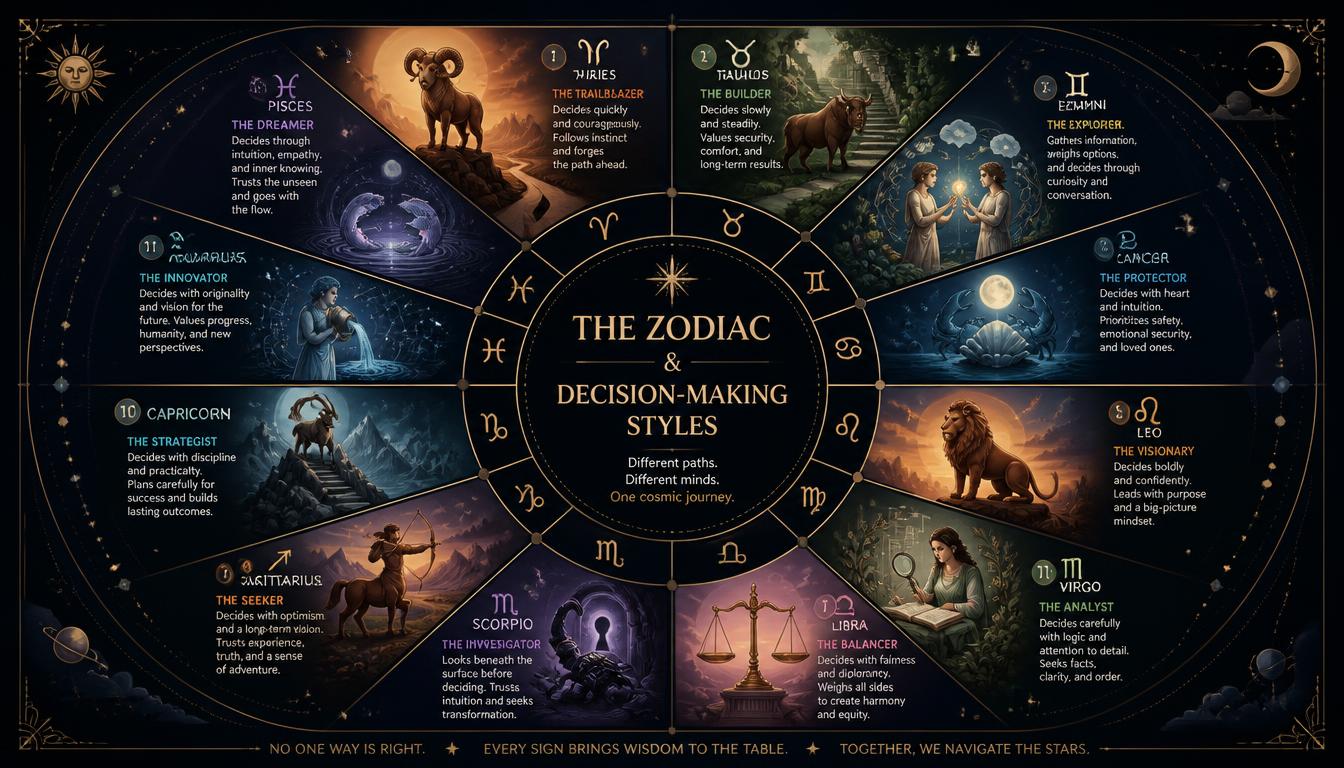
Traditional astrology also describes the 12 zodiac signs through different symbolic decision-making tendencies.
Aries may be associated with speed.
Taurus with caution.
Gemini with possibilities.
Cancer with emotional security.
Leo with confidence.
Virgo with analysis.
Libra with comparison.
Scorpio with trust.
Sagittarius with opportunity.
Capricorn with long-term consequences.
Aquarius with independence.
Pisces with intuition and emotional meaning.
These descriptions should not be treated as scientific rules.
But they can be interesting reflection prompts.
Instead of asking:
“Which zodiac sign makes the best decisions?”
a more useful question is:
“What does my natural decision style help me see—and what might it cause me to overlook?”
That is the focus of this guide.
Astrology note: Zodiac signs are not scientifically proven predictors of decision-making ability, intelligence, judgment, risk tolerance, financial choices, relationship decisions, or behavior. This guide uses traditional astrology for entertainment, cultural interest, and self-reflection. Important decisions should be based on relevant facts, circumstances, risks, and appropriate professional guidance where needed.
Decision Style Is Not Decision Quality
Fast decisions are not automatically bad.
Slow decisions are not automatically wise.
Emotional decisions are not automatically irrational.
Analytical decisions are not automatically correct.
Every style has useful situations.
For example:
A fast decision can be valuable during a simple low-risk situation.
A careful decision can prevent expensive mistakes.
Emotional information can reveal personal values.
Analysis can expose hidden costs.
Problems usually appear when one style is used for every type of decision.
Someone who analyzes every tiny choice may waste time.
Someone who acts instantly on every major choice may create unnecessary risk.
The goal is flexibility.
Four Questions Behind Almost Every Decision
Before looking at each zodiac sign, consider four basic dimensions.
1. Speed
How quickly do you want an answer?
2. Information
How much evidence do you need?
3. Emotion
How strongly do feelings influence the choice?
4. Risk
How comfortable are you with uncertainty?
Different signs are traditionally associated with different combinations of these tendencies.
Aries Decision-Making Style: Fast and Action-First
Traditional Aries symbolism emphasizes:
Initiative.
Courage.
Action.
Speed.
Independence.
An Aries-style decision-maker may prefer:
Decide → Act → Adjust
rather than:
Analyze → Analyze More → Decide
This can be extremely useful when hesitation is the main obstacle.
How Aries May Decide
Aries may:
Choose quickly.
Trust the first strong instinct.
Prefer action over discussion.
Take calculated—or sometimes uncalculated—risks.
Become frustrated when too many people need to approve.
Aries Decision Strength
Momentum
Aries may prevent opportunities from disappearing through endless hesitation.
They can make something happen while others are still preparing.
Aries Blind Spot
Acting before discovering the real cost.
Speed can hide:
Missing information.
Long-term consequences.
Dependencies.
Financial impact.
Other people’s commitments.
Aries Decision Tool: The Three-Breath Gate
Before a meaningful decision, pause long enough to answer:
What do I gain?
What could this cost?
What information would make me change my mind?
If the third answer reveals missing information, investigate before acting.
Aries does not need to become slow.
It may simply need one gate between impulse and action.
Taurus Decision-Making Style: Careful and Stability-Focused
Traditional Taurus symbolism emphasizes:
Stability.
Practicality.
Patience.
Security.
Consistency.
A Taurus-style decision-maker may prefer familiar, dependable choices.
They may ask:
“Is this safe?”
“Is this sustainable?”
“Will I regret changing what already works?”
How Taurus May Decide
Taurus may:
Take time.
Compare practical consequences.
Prefer proven options.
Avoid unnecessary risk.
Stick strongly with a decision once made.
Taurus Decision Strength
Stability awareness
Taurus may notice the hidden cost of disruption.
A new option may look exciting.
But Taurus may ask:
“What happens to everything I already built?”
That question is often valuable.
Taurus Blind Spot
Treating familiar as automatically safer.
Sometimes the current situation has a cost too.
Staying can also be a decision.
Taurus Decision Tool: The Stay-vs-Change Ledger
Create two columns.
Cost of Changing
Money.
Time.
Uncertainty.
Learning.
Disruption.
Cost of Staying
Missed opportunity.
Stagnation.
Continued frustration.
Future risk.
Then compare both.
Do not evaluate only the risk of change.
Gemini Decision-Making Style: Curious and Possibility-Driven
Traditional Gemini symbolism emphasizes:
Curiosity.
Information.
Communication.
Flexibility.
Multiple perspectives.
A Gemini-style decision-maker may quickly see many possible outcomes.
This can make them mentally agile.
But it can also make simple decisions feel complicated.
How Gemini May Decide
Gemini may:
Research extensively.
Ask multiple people.
Change opinion after new information.
Create several scenarios.
Keep reopening the decision.
Gemini Decision Strength
Alternative generation
Gemini may notice an option nobody else considered.
Instead of:
A or B,
they may discover:
C, D, and E.
Gemini Blind Spot
Confusing more information with better information.
At some point, additional research stops improving the decision.
Gemini Decision Tool: The Information Stop Rule
Before researching, define:
What do I need to know?
Which three facts matter most?
What deadline will end the research?
Once those conditions are met, decide.
Without a stopping rule, curiosity can turn into decision delay.
Cancer Decision-Making Style: Emotional-Security Focused
Traditional Cancer symbolism emphasizes:
Emotion.
Security.
Family.
Care.
Protection.
A Cancer-style decision-maker may think not only about:
“What happens to me?”
but also:
“How will this affect everyone I care about?”
How Cancer May Decide
Cancer may:
Consider emotional consequences.
Think about family impact.
Prioritize security.
Remember previous experiences.
Delay choices that may upset loved ones.
Cancer Decision Strength
Human impact awareness
Cancer-style decision-making may notice consequences that purely practical analysis misses.
A decision can be financially efficient but emotionally damaging.
That matters.
Cancer Blind Spot
Making other people’s comfort the deciding factor.
Care is important.
But responsibility for everyone’s emotional reaction can make personal decisions impossible.
Cancer Decision Tool: The Three-Circle Decision
Draw three circles.
Circle 1 — My Responsibility
What is genuinely mine to decide?
Circle 2 — Shared Impact
Who deserves consultation?
Circle 3 — Other People’s Reaction
What belongs to them?
This helps Cancer care without giving away the entire decision.
Leo Decision-Making Style: Confident and Identity-Driven
Traditional Leo symbolism emphasizes:
Confidence.
Leadership.
Self-expression.
Pride.
Visibility.
A Leo-style decision-maker may ask:
“Which choice feels true to who I am?”
They may make decisions boldly when they believe in themselves.
How Leo May Decide
Leo may:
Trust personal judgment.
Choose decisively.
Consider reputation.
Prefer options that allow expression or leadership.
Resist choices that feel humiliating or diminishing.
Leo Decision Strength
Commitment
Once emotionally invested in a decision, Leo may bring strong energy to carrying it out.
Leo Blind Spot
Choosing what protects pride rather than what produces the best outcome.
Sometimes changing direction feels like losing.
It is not.
Leo Decision Tool: The No-Audience Decision
Ask:
“If nobody knew I made this choice, what would I choose?”
No applause.
No status.
No embarrassment.
No audience.
This separates genuine preference from image-management.
Virgo Decision-Making Style: Analytical and Detail-Oriented
Traditional Virgo symbolism emphasizes:
Analysis.
Accuracy.
Organization.
Improvement.
Practicality.
A Virgo-style decision-maker may want enough information to reduce mistakes.
They may examine:
Price.
Quality.
Timing.
Evidence.
Risks.
Details.
How Virgo May Decide
Virgo may:
Compare carefully.
Look for flaws.
Research extensively.
Create criteria.
Delay when too many details remain uncertain.
Virgo Decision Strength
Error detection
Virgo may catch the small issue that becomes a large problem later.
Virgo Blind Spot
Expecting uncertainty to disappear completely.
Most meaningful decisions contain some uncertainty.
Perfect information rarely arrives.
Virgo Decision Tool: The Decision Sufficiency Score
Score the choice from 1 to 5 on:
Information.
Risk understanding.
Affordability.
Practicality.
Alignment with goal.
If the important categories are strong enough, ask:
“What meaningful information am I still missing?”
If the answer is:
“Nothing significant,”
the remaining discomfort may be uncertainty rather than lack of research.
Libra Decision-Making Style: Comparative and Fairness-Oriented
Traditional Libra symbolism emphasizes:
Balance.
Fairness.
Relationships.
Diplomacy.
Multiple perspectives.
A Libra-style decision-maker may see both sides almost too well.
Option A has advantages.
But B has advantages too.
And what about C?
How Libra May Decide
Libra may:
Compare options extensively.
Ask for opinions.
Consider fairness.
Think about other people’s preferences.
Delay final commitment.
Libra Decision Strength
Perspective balance
Libra-style thinking can prevent one-sided choices.
Libra Blind Spot
Giving every opinion equal weight.
Not every person is equally affected.
Not every opinion is equally informed.
Libra Decision Tool: The Weighted Voice Method
List the people influencing the decision.
Assign each voice a weight.
For example:
My preference — 40%
Partner directly affected — 30%
Expert advice — 20%
Friends’ opinions — 10%
The percentages will vary.
The point is:
Do not let ten casual opinions outweigh one informed or personally important perspective.
Scorpio Decision-Making Style: Strategic and Trust-Focused
Traditional Scorpio symbolism emphasizes:
Depth.
Trust.
Privacy.
Control.
Observation.
A Scorpio-style decision-maker may look beyond the obvious option.
They may ask:
“What is really happening?”
“What am I not being told?”
“Who benefits from this?”
How Scorpio May Decide
Scorpio may:
Observe quietly.
Research privately.
Look for inconsistencies.
Evaluate trust.
Avoid revealing their final position too early.
Scorpio Decision Strength
Motive awareness
Scorpio-style thinking may notice hidden incentives and trust issues others overlook.
Scorpio Blind Spot
Allowing suspicion to become evidence.
A possibility is not proof.
Scorpio Decision Tool: The Fact-Motive Split
Create two sections.
Verified Facts
What can be demonstrated?
Suspected Motives
What do I think may be happening?
Never move something into the first category without evidence.
Then ask:
“Would I make the same decision if I removed the suspected motive?”
If not, the suspicion deserves stronger verification.
Sagittarius Decision-Making Style: Opportunity and Big-Picture Focused
Traditional Sagittarius symbolism emphasizes:
Freedom.
Exploration.
Optimism.
Growth.
Opportunity.
A Sagittarius-style decision-maker may focus on what could become possible.
They often ask:
“Where could this take me?”
How Sagittarius May Decide
Sagittarius may:
Choose exciting possibilities.
Accept uncertainty.
Take bigger risks.
Focus on upside.
Prefer choices that increase freedom.
Move quickly when an opportunity feels expansive.
Sagittarius Decision Strength
Opportunity recognition
Sagittarius may see potential where others mainly see risk.
Sagittarius Blind Spot
Evaluating the opportunity without calculating the obligation.
Every yes consumes:
Time.
Money.
Attention.
Energy.
Sagittarius Decision Tool: The Opportunity Price Tag
Before saying yes, write:
What can I gain?
What will this require every week?
What existing commitment loses time?
What happens if the excitement disappears?
Can I exit reasonably if it does not work?
This adds reality without eliminating optimism.
Capricorn Decision-Making Style: Long-Term and Consequence-Focused
Traditional Capricorn symbolism emphasizes:
Responsibility.
Structure.
Ambition.
Discipline.
Long-term planning.
A Capricorn-style decision-maker may think several steps ahead.
Not:
“What feels good today?”
but:
“What will this look like three years from now?”
How Capricorn May Decide
Capricorn may:
Think about long-term consequences.
Consider financial or practical responsibility.
Prefer structured options.
Delay gratification.
Choose the harder path if it offers future value.
Capricorn Decision Strength
Future-cost awareness
Capricorn-style thinking may prevent short-term convenience from creating long-term problems.
Capricorn Blind Spot
Making the most responsible choice even when it is no longer the most meaningful choice.
Duty can become automatic.
Capricorn Decision Tool: The Future-Self Interview
Imagine yourself three years ahead.
Ask that future version:
What did this decision give me?
What did it cost me?
What do I wish I had protected?
Was the sacrifice temporary—or did it become permanent?
Capricorn already thinks long-term.
This exercise makes long-term thinking broader than career or money alone.
Aquarius Decision-Making Style: Independent and Principle-Driven
Traditional Aquarius symbolism emphasizes:
Independence.
Innovation.
Ideas.
Originality.
Nonconformity.
An Aquarius-style decision-maker may value:
“What makes sense to me?”
more than:
“What does everybody normally do?”
How Aquarius May Decide
Aquarius may:
Challenge conventional options.
Ignore social pressure.
Choose unusual solutions.
Think conceptually.
Prefer autonomy.
Aquarius Decision Strength
Independent thinking
Aquarius may avoid bad decisions caused purely by conformity.
Aquarius Blind Spot
Rejecting an option because it is conventional rather than because it is bad.
Being different is not automatically better.
Aquarius Decision Tool: The Conventionality Removal Test
Take the label away.
Do not ask:
“Is this traditional?”
or:
“Is this unusual?”
Ask:
Does it work?
Is it ethical?
Is it practical?
Does it match my actual goal?
What evidence supports it?
The best decision may be conventional.
Or completely original.
That should not be predetermined.
Pisces Decision-Making Style: Intuitive and Meaning-Focused
Traditional Pisces symbolism emphasizes:
Imagination.
Sensitivity.
Intuition.
Compassion.
Idealism.
A Pisces-style decision-maker may strongly notice:
How a choice feels.
What it means emotionally.
Who could be hurt.
What future they can imagine.
How Pisces May Decide
Pisces may:
Follow intuition.
Imagine future possibilities.
Consider emotional impact.
Be influenced by compassion.
Delay when reality and hope conflict.
Pisces Decision Strength
Meaning awareness
Pisces may notice that the technically “best” option is not always the personally meaningful one.
Pisces Blind Spot
Allowing hope to replace evidence.
The imagined future can become more persuasive than current reality.
Pisces Decision Tool: The Dream-and-Proof Page
Split a page in half.
Dream
What do I hope will happen?
Proof
What evidence suggests it is realistically possible?
Then ask:
“What would I decide if I respected both?”
This preserves imagination without allowing imagination to become the only evidence.
12 Zodiac Signs: Decision-Making Snapshot
| Zodiac Sign | Symbolic Decision Style | Main Strength | Common Blind Spot | Useful Tool |
|---|---|---|---|---|
| Aries | Fast, action-first | Momentum | Acting too soon | Three-Breath Gate |
| Taurus | Careful, stability-focused | Practical caution | Fear of change | Stay-vs-Change Ledger |
| Gemini | Information-driven | Multiple options | Endless research | Information Stop Rule |
| Cancer | Emotional-security focused | Human impact | Carrying others’ reactions | Three-Circle Decision |
| Leo | Confident, identity-driven | Commitment | Pride | No-Audience Decision |
| Virgo | Analytical | Error detection | Analysis paralysis | Sufficiency Score |
| Libra | Comparative | Fairness | Too many opinions | Weighted Voice Method |
| Scorpio | Strategic | Trust awareness | Suspicion | Fact-Motive Split |
| Sagittarius | Opportunity-focused | Possibility | Underestimating cost | Opportunity Price Tag |
| Capricorn | Long-term | Future planning | Duty over meaning | Future-Self Interview |
| Aquarius | Independent | Original thinking | Rejecting convention automatically | Conventionality Removal Test |
| Pisces | Intuitive | Meaning awareness | Idealization | Dream-and-Proof Page |
These are traditional symbolic tendencies, not scientific classifications.
Which Zodiac Signs Are Fast Decision-Makers?
Within traditional astrology, Aries and Sagittarius may be associated with faster decisions.
Aries may act because:
Action feels better than waiting.
Sagittarius may act because:
Opportunity feels worth exploring.
Leo can also decide quickly when confidence is high.
But speed does not guarantee quality.
Fast decision-makers benefit from short checkpoints rather than endless analysis.
Which Zodiac Signs Are More Careful?
Traditional astrology may associate Taurus, Virgo, and Capricorn with more deliberate decision-making.
Taurus may evaluate stability.
Virgo may evaluate details.
Capricorn may evaluate long-term consequences.
Their challenge may be recognizing when caution has already done its job.
Which Zodiac Signs May Use Emotion More Heavily?
Traditional water-sign symbolism connects Cancer, Scorpio, and Pisces with emotional or intuitive awareness.
But each uses it differently.
Cancer may focus on emotional security.
Scorpio may focus on trust.
Pisces may focus on meaning and compassion.
Emotion itself is not the problem.
The useful question is:
“Is the feeling providing information—or replacing information?”
Which Zodiac Signs May Be More Analytical?
Traditional astrology may portray Gemini, Virgo, Libra, Aquarius, and Capricorn as using strong mental or practical analysis in different ways.
Gemini explores possibilities.
Virgo examines details.
Libra compares sides.
Aquarius questions assumptions.
Capricorn studies long-term consequences.
Their challenge can be moving from thinking to choosing.
Fire Signs and Decisions
The fire signs are:
Aries, Leo, Sagittarius.
Traditional astrology connects fire with:
Action.
Confidence.
Energy.
Expansion.
Fire-style decision-making may ask:
“What do I want to do?”
The strength is momentum.
The danger is insufficient review.
A useful fire-sign question is:
“What would I notice if I slowed down by 10%?”
Not 90%.
Just enough to see what speed may be hiding.
Earth Signs and Decisions
The earth signs are:
Taurus, Virgo, Capricorn.
Traditional astrology connects earth with:
Practicality.
Stability.
Structure.
Results.
Earth-style decision-making may ask:
“Will this actually work?”
The strength is realism.
The danger is overvaluing certainty.
A useful earth-sign question is:
“Am I waiting for useful information—or impossible certainty?”
Air Signs and Decisions
The air signs are:
Gemini, Libra, Aquarius.
Traditional astrology connects air with:
Thought.
Ideas.
Perspective.
Communication.
Air-style decision-making may ask:
“What are the possibilities?”
The strength is perspective.
The danger is remaining mentally outside the decision for too long.
A useful air-sign question is:
“What information is still genuinely necessary?”
Water Signs and Decisions
The water signs are:
Cancer, Scorpio, Pisces.
Traditional astrology connects water with:
Emotion.
Intuition.
Sensitivity.
Depth.
Water-style decision-making may ask:
“How does this feel?”
The strength is recognizing human meaning.
The danger is treating an emotional signal as complete evidence.
A useful water-sign question is:
“What do I feel, and what do I know?”
Keep both answers.
Cardinal Signs: Decisions That Start Movement
The cardinal signs are:
Aries, Cancer, Libra, Capricorn.
Traditional astrology associates cardinal energy with initiation.
But they initiate differently.
Aries:
Action.
Cancer:
Protection.
Libra:
Agreement.
Capricorn:
Structure.
Their decision challenge may be feeling responsible for creating movement.
Sometimes the best decision is to wait for information rather than force progress.
Fixed Signs: Decisions That Are Hard to Reverse
The fixed signs are:
Taurus, Leo, Scorpio, Aquarius.
Traditional astrology associates fixed signs with persistence.
Once decided, they may stay committed.
That can create consistency.
But it can also produce the Sunk Decision Problem:
“I already chose this, so I must continue.”
Past commitment alone is not proof that continuing is wise.
The Fixed-Sign Reconsideration Question
Ask:
“If I had not already invested time, money, pride, or energy into this, would I choose it today?”
If the answer is no, current evidence deserves attention.
Mutable Signs: Decisions That Keep Changing
The mutable signs are:
Gemini, Virgo, Sagittarius, Pisces.
Traditional astrology associates mutable signs with adaptability.
That flexibility can be useful.
But too much flexibility can make the decision unstable.
A useful mutable-sign rule is:
Define what evidence is strong enough to reopen a decision.
Not every new thought deserves a complete restart.
The Reversible vs Irreversible Decision Test
One of the most useful decision-making distinctions has nothing to do with zodiac signs.
Ask:
Is this decision easily reversible?
Examples might include:
Trying a new software tool.
Testing a content format.
Trying a new routine.
Low-cost experiments.
These may deserve faster decisions.
Is this decision difficult or expensive to reverse?
Examples might include:
Major financial commitments.
Legal agreements.
Serious medical choices.
Marriage.
Major property purchases.
Large business investments.
These generally deserve more careful evidence and appropriate expert guidance where needed.
Decision speed should partly depend on reversibility.
The Two-Door Method
Imagine two doors.
Door A — Easy Return
If the decision fails, you can return cheaply.
Move faster.
Door B — Difficult Return
Reversing the choice may involve major:
Money.
Time.
Health.
Legal consequences.
Relationships.
Move more carefully.
This prevents using the same decision process for buying lunch and buying a house.
The Decision Size Ladder
Classify decisions before spending mental energy.
Level 1 — Tiny
Minimal consequence.
Choose quickly.
Level 2 — Small
Some consequence but easily reversible.
Use limited comparison.
Level 3 — Medium
Meaningful impact.
Review facts and risks.
Level 4 — Major
Long-term impact.
Slow down.
Consult relevant people.
Verify important information.
Level 5 — High Stakes
Health.
Legal.
Large financial commitments.
Safety.
Major life consequences.
Use qualified professional guidance where appropriate.
This protects people from both:
Overthinking small decisions.
And underthinking serious ones.
The Zodiac Decision Matrix
For a meaningful but non-emergency decision, score each option from 1 to 5.
Practicality
Can I realistically do this?
Cost
Can I afford the time, money, and energy?
Risk
What happens if it goes badly?
Meaning
Does this matter to me?
Evidence
What supports the expected outcome?
Reversibility
Can I change direction later?
Impact on Others
Who is directly affected?
Then compare totals.
Numbers do not make the decision automatically.
They make hidden assumptions visible.
Head, Heart and Reality
Many decisions become clearer when separated into three voices.
Head
What does logic say?
Heart
What do I genuinely want or value?
Reality
What do the facts, resources, and circumstances allow?
A decision may become risky when one voice completely silences the others.
For example:
Heart says:
“I love this idea.”
Reality says:
“I cannot afford it.”
That does not mean the dream must disappear.
It may mean:
Not yet.
Or:
Find a smaller version.
The Regret Test
Imagine two versions of future regret.
Regret of Action
“What if I do this and it fails?”
Regret of Inaction
“What if I never try?”
People often consider only the first.
A balanced decision considers both.
The Minimum Evidence Rule
Before making an important choice, identify:
One fact supporting it.
One fact against it.
One uncertainty.
One risk-management action.
This prevents decisions from becoming arguments designed only to justify what you already want.
The Decision Journal
For decisions that matter, record:
The Decision
What did I choose?
Why
What were the three main reasons?
What I Expect
What do I think will happen?
Biggest Risk
What could go wrong?
Review Date
When will I evaluate the result?
Later, compare prediction with reality.
Over time, this reveals your actual decision habits.
Maybe you discover:
You underestimate costs.
Overestimate risks.
Trust certain people too much.
Quit too early.
Research too long.
Or make surprisingly good intuitive decisions in certain areas.
That information is more useful than simply labeling yourself a “good” or “bad” decision-maker.
The Decision Autopsy
When a decision goes badly, avoid asking only:
“Why did I make such a bad decision?”
Instead, perform a short autopsy.
Information
What did I know at the time?
Unknowns
What could I not reasonably have known?
Process
Was my decision process reasonable?
Bias
What distorted my judgment?
Lesson
What should I do differently next time?
A bad outcome does not always mean the original decision process was bad.
Sometimes good decisions produce bad outcomes because uncertainty exists.
And sometimes careless decisions produce lucky outcomes.
Judge the process too.
When Intuition Can Help—and When It Should Not Be Enough
Intuition may be useful when:
You have significant experience.
You recognize familiar patterns.
The decision is low-risk.
You need to act with limited time.
But intuition deserves more caution when:
You have little experience.
The stakes are high.
Strong emotions are involved.
Large amounts of money are involved.
Health or safety is involved.
Important facts can be checked.
In those situations:
Intuition can contribute to the decision without being the entire decision.
Important Decisions Should Not Be Made Through Astrology Alone
A horoscope or zodiac description should not determine:
Medical treatment.
Mental-health treatment.
Legal action.
Large investments.
Debt decisions.
Property purchases.
Marriage or divorce.
Career resignation.
Pregnancy or fertility decisions.
Safety decisions.
These areas require real-world information and, where appropriate, qualified professional advice.
Astrology may be used as entertainment or a self-reflection prompt.
It should not replace evidence.
Frequently Asked Questions
Which zodiac sign makes decisions the fastest?
Traditional astrology often portrays Aries as a fast, action-oriented decision-maker. Sagittarius may also make quick choices when an opportunity feels exciting. Individual behavior varies widely.
Which zodiac sign is the most careful decision-maker?
Taurus, Virgo, and Capricorn are commonly associated with more cautious or practical decision-making in traditional astrology, but there is no scientific evidence that zodiac signs determine decision quality.
Which zodiac sign overthinks decisions?
Gemini, Virgo, and Libra are often stereotypically associated with extensive thinking or comparison, though anyone can experience indecision or analysis paralysis.
Which zodiac signs make emotional decisions?
Traditional water-sign symbolism connects Cancer, Scorpio, and Pisces with stronger attention to emotion, intuition, trust, and emotional meaning. This does not mean they are irrational decision-makers.
Is Aries impulsive when making decisions?
Traditional Aries symbolism emphasizes speed and action, which contributes to the impulsive stereotype. Real impulsivity is influenced by many factors beyond zodiac signs.
Why does Taurus take so long to decide?
Taurus symbolism emphasizes stability and security, so traditional interpretations may describe Taurus as cautious about disruptive changes.
Why does Gemini keep changing decisions?
Gemini symbolism emphasizes curiosity and multiple perspectives. In this framework, new information may repeatedly reopen the choice.
Why is Libra indecisive?
Traditional Libra symbolism emphasizes balance and consideration of multiple perspectives, which can sometimes be interpreted as difficulty choosing between competing options.
Does Scorpio trust intuition when deciding?
Traditional Scorpio symbolism often emphasizes observation, trust, and hidden motives. However, intuition should not be confused with verified evidence.
Why does Sagittarius take risks?
Sagittarius symbolism emphasizes freedom, optimism, exploration, and opportunity. In traditional astrology, these qualities may be associated with greater comfort around uncertainty.
How does Capricorn make important decisions?
Capricorn is traditionally associated with responsibility, long-term planning, structure, and consequences, so the symbolic decision style tends to be future-oriented.
Does Aquarius ignore other people’s opinions?
Aquarius is traditionally associated with independent thinking and nonconformity. Healthy independence does not require rejecting useful advice.
Does Pisces follow the heart when deciding?
Traditional Pisces symbolism emphasizes intuition, compassion, imagination, and emotional meaning. Practical evidence remains important for major decisions.
Can zodiac signs predict whether someone will make good decisions?
No. There is no scientific evidence that zodiac signs reliably predict intelligence, judgment, financial decision-making, or life outcomes.
Final Thoughts
Every decision style solves one problem while creating another risk.
Aries solves hesitation.
But may create impulsiveness.
Taurus protects stability.
But may resist necessary change.
Gemini discovers possibilities.
But may never stop researching.
Cancer considers human impact.
But may carry responsibility that belongs to others.
Leo brings confidence.
But pride can distort the choice.
Virgo catches errors.
But may wait for impossible certainty.
Libra sees every side.
But may forget their own side.
Scorpio notices trust and motive.
But suspicion can outrun evidence.
Sagittarius sees opportunity.
But may underestimate obligation.
Capricorn sees the future.
But duty can overshadow meaning.
Aquarius thinks independently.
But unconventionality can become a goal by itself.
Pisces recognizes meaning and possibility.
But hope can become stronger than evidence.
None of these symbolic styles is automatically superior.
The strongest decision-maker is not necessarily the fastest.
Or the most careful.
Or the most emotional.
Or the most analytical.
It is the person who can recognize:
What kind of decision is this?
How high are the stakes?
How reversible is it?
What facts matter?
What do I genuinely value?
What am I afraid of?
What am I overlooking because of my usual style?
And then choose a process that matches the decision.
Sometimes the right move is:
Act quickly.
Sometimes:
Research.
Sometimes:
Ask for advice.
Sometimes:
Trust experience.
Sometimes:
Wait.
And sometimes:
Accept that no option comes with complete certainty.
The goal of better decision-making is not eliminating uncertainty.
It is making uncertainty manageable enough that you can choose without pretending you know the future.
So rather than asking:
“What would my zodiac sign choose?”
try asking:
“What would the clearest version of me notice before choosing?”
That question leaves room for intuition.
Reason.
Emotion.
Experience.
And reality.
All at the same table.
About This Guide
This article was prepared for Star Horoscope as an editorial guide exploring traditional zodiac symbolism, decision-making tendencies, risk, intuition, analysis, and self-reflection.
Star Horoscope publishes zodiac and astrology content for entertainment, cultural interest, and personal reflection. Zodiac signs are not scientifically proven predictors of intelligence, judgment, financial decisions, relationship choices, or life outcomes.
Published by: Star Horoscope Editorial Team
Content Category: Zodiac Signs / Decision-Making & Self-Reflection
Editorial Approach: Traditional astrology interpreted through practical decision-making, risk awareness, evidence, emotional insight, and self-reflection themes
Last Updated: September 2026

Leave a Reply